Monday, July 31, 2023

End-of-season assessment of blackleg of canola (PCDMN)

The spring and summer of 2023 was challenging for Prairie producers who experienced very dry conditions, especially under dryland production.  Although this limited disease issues, the drought stress had a very significant negative impact on stand establishment, crop growth, and yield.  However, some Prairie regions did receive moisture during the course of the summer and in these regions field crop diseases may be more of a concern.

Blackleg is one of the key diseases faced by Prairie canola producers and has largely been kept in check with the use of resistant varieties and crop rotation.  However, over the past 10-20 years there have been concerns regarding observed shifts in blackleg pathogen virulence in response to the major gene resistance used in a number of varieties. 

Changes in virulence patterns emphasize the critical need to stay on top of this disease; producers and crop scouts can play a critical role by scouting fields to monitor blackleg and detect any unexpected increases in disease levels on resistant varieties.  For blackleg a critical time for scouting is later in the season to assess the prevalence, severity and impact of this disease issue. 

When assessing blackleg incidence and severity, it is critical to correctly identify symptoms of blackleg and differentiate these from normal or premature canola crop ripening due to a range of abiotic and biotic factors.  Recent Prairie research has shown limited responses to in-crop fungicide when resistant varieties are grown, and especially where this resistance is still highly effective. 

Mid-season blackleg leaf lesion


Mid-season blackleg leaf lesion


Cross section of late-season blackleg stem base infection


Cross section of late-season blackleg stem base infection


Late-season blackleg stem base infection/canker


Late-season blackleg stem base infection/canker


Access the latest survey protocols and scouting information for blackleg of canola at: 

Blackleg survey protocols 

Blackleg scouting information

Blackleg disease info card

End-of-season assessment of the ascochyta/mycosphaerella complex of field pea (PCDMN)

The spring and summer of 2023 was challenging for Prairie producers who experienced very dry conditions, especially under dryland production.  Although this limited disease issues, the drought stress had a very significant negative impact on stand establishment, crop growth, and yield.  However, some Prairie regions did receive moisture during the course of the summer and in these regions field crop diseases may be more of a concern.

During June and July, crop scouting for the ascochyta/mycosphaerella complex in field pea is critical for assessing risk and gauging the need for and timing of an in-crop fungicide application.  However, late season crop scouting is also important as it can be used to assess the prevalence, severity and impact of these disease issues.  Where unsprayed check strips or areas have been left in the field, late season assessments can be used to assess the impact and benefit of spraying in relation to leaf disease management and crop productivity. 

It is critical to assess end-of-season leaf spot levels at the correct growth stage although the same scale can be used at early flowering to gauge disease development and the need to apply fungicide.  Assessment of leaf diseases becomes very difficult if plants have started to ripen.

Symptoms of mycosphaerella/ascochyta complex

Symptoms of mycosphaerella/ascochyta complex


Symptoms of mycosphaerella/ascochyta complex


Access suggested survey protocols and scouting information for the ascochyta/mycosphaerella complex for field pea at:

Ascochyta/mycosphaerella survey protocols

Ascochyta/mycosphaerella scouting information

Ascochyta/mycosphaerella disease info card

Monday, July 24, 2023

Prairie soil moisture and rainfall maps: July 16-23, 2023

Prairie soil moisture levels and need to scout for apothecia of the sclerotinia stem rot pathogen, July 16-23, 2023

Based on satellite data from July 10-16, 2023, large areas of the Prairies are still dealing with dry conditions and would only have <5 to 15% of surface soil moisture (VMC) (Figure 1). Corresponding, satellite images for July 10-16, 2023, 2023 show below long term average soil moisture levels for large areas of the Prairies, including regions where sclerotinia stem rot can occur (Figure 2). Previously, some areas including the Edmonton region to eastern Alberta and a small area of northwestern Saskatchewan were seeing somewhat higher soil moisture levels, but during the period of July 10-16 moisture levels appear to be decreasing (Figures 1 and 2).  Note since July 9, regional weather and storm systems may have resulted in localized rainfall events that can contribute to and maintain soil moisture, which may promote sclerotial germination and apothecia production. Regions with 20 to over 95 mm accumulated rainfall in the past 14 days as of July 23, 2023 include broad areas of central and northern Alberta and pockets in the Peace Region, Saskatchewan, and Manitoba (Figure 3).

As of July 16-23, the need to scout fields for apothecia of the stem rot fungus and/or to assess in-field risk are generally low, although the risk may be somewhat higher where rainfall has occurred and crops have not been compromised by dry conditions in June and July (Figure 3).  Most canola is well into flowering, while early seeded and/or drought stressed fields are likely finishing flowering.  In Prairie regions, past and current rainfall will likely trigger the start and/or continuation of the sclerotial germination process, which can take up to three weeks (Figure 3).  Further rainfall may increase the risk of sclerotial germination and apothecia production.  Some areas in Alberta, Saskatchewan and Manitoba may still have soil moisture conditions somewhat conducive for sclerotial germination, especially were localized rainfall has occurred (Figure 3).  In these areas, in-crop scouting for apothecia and the use of available stem rot risk assessment tools may be needed over the next 1-2 weeks as part of fungicide use decisions (https://www.canolacouncil.org/canola-encyclopedia/diseases/sclerotinia-stem-rot/#forecasting-and-risk-assessment, https://tinyurl.com/bp6dchvx).   

Previously, the PCDMN tweeted some tips for practical assessment of the risk of sclerotinia stem rot, including the wet pants test, and these will complement the other tools that are available.  See: https://twitter.com/pcdmn/status/1143578383537889281 and https://drive.google.com/file/d/1cC1gNcLq-L5Dk2tUXG-vmEmW_6oJ-kAd/view?usp=sharing.

Background information on the soil moisture maps can be found at the following link: New for 2023: Prairie Soil Moisture Maps.

Given dry conditions, especially prior to mid-June, sclerotial germination would be delayed, although recent rains in some regions have likely triggered the germination process. Normally it takes about 3 weeks of wet soil conditions and moderate temperatures for germination and production of apothecia.  This period may be as short as 2 weeks if some moisture was received earlier in June, which may pre-condition sclerotia.  Delayed germination and apothecia development may mean that sclerotinia spore loads in the air are limited as the crop or portions of the crop come into bloom in 2023.  This may mean that an early bloom fungicide application may not represent the best target.  However, in crops with reasonable yield potential and where risk tools indicate increasing risk as flowering continues, later fungicide application at full bloom may be considered.  Note in areas were rainfall occurred and soil moisture levels are conducive, later seeded canola may be at risk during the early bloom; to mid-bloom period.  Tools such as the Spornado spore trap (https://2020seedlabs.ca/services/spornado/) and petal testing services (https://www.seedtesting.com/disease-testing-sclerotinia/; https://quantumgenetix.com/product/sclerotinia-white-mold/) can provide guidance related to the level of sclerotinia inoculum and stem rot risk as the crop starts and continues to flower.  Note these need to be combined with other risk tools to provide a complete picture of stem rot risk in relation to host, pathogen and environment factors, i.e. the disease triangle.  If fungicides are being considered, accounting for the most common crop growth stage in a field should be considered to help guide the timing(s) used.  Fortunately, most fungicide products have a window from 20-50% bloom, which represents a range of growth stages.  Note available risk assessment tools will provide information related to stem rot risk and whether a fungicide is needed from 20-50% bloom.


Figure 1.  Percent saturated surface soil moisture from Soil Moisture and Ocean Salinity (SMOS) data, July 10-16, 2023.  Courtesy of Agriculture and Agri-Food Canada's Agroclimate Geomatics and Earth Observation Division. 


Figure 2.  Difference from long term average, percent saturated surface soil moisture from the Soil Moisture and Ocean Salinity (SMOS) data, July 10-16, 2023.  Courtesy of Agriculture and Agri-Food Canada's Agroclimate Geomatics and Earth Observation Division.


Figure 3. Fourteen day cumulative rainfall (mm) as of July 23, 2023 observed across the Canadian prairies. Prepared by Agriculture and Agri-Food Canada's Science and Technology Branch. Data provided through partnership with Environment Canada, Natural Resources Canada, Provincial and private agencies.  

Disclaimer

Information related to soil moisture is OFFERED TO THE PUBLIC FOR INFORMATIONAL PURPOSES ONLY. Agriculture and Agri-Food Canada, and their employees assume no liability from the use of this information.  Soil moisture conditions will vary depending on soil texture, and localized rainfall and temperature conditions.  Sclerotinia stem rot risk will vary depending on host, pathogen and weather factors, and farmers and consultants are encouraged to use currently available risk assessment tools (https://www.canolacouncil.org/canola-encyclopedia/diseases/sclerotinia-stem-rot/#forecasting-and-risk-assessment).  Mention of a particular product or service does not represent an endorsement by PCDMN or the organizations involved with the PCDMN.

2023 Cereal Rust Risk Report (Mini and final update for June 18-July 21, 2023)

The main period for rust risk is largely over for most spring-seeded cereals.  Typically, the greatest impacts occur when rust arrives prior to head emergence.  Arrival of rust after head emergence and during the grain filling period will have a lower impact, although low to moderate yield losses can occur for susceptible varieties.  

Sources of rust are primarily from the Pacific Northwest (stripe rust), Texas/Oklahoma (leaf, stripe, stem, crown rust), and the Kansas/Nebraska (leaf, stripe, stem, crown rust) regions of the USA.  However, once crops in these regions start to mature and then are harvested they no longer represent a significant source or cereal rust for Prairie cereal crops.  As of July 16, 2023 winter wheat harvest in TX/OK is largely complete, while 71 and 21% of the winter wheat in Kansas and Nebraska has been harvested, respectively (https://quickstats.nass.usda.gov/results/EDA8B6A4-E4E5-32B1-9FFB-E39C78983A28).  The oat crop in Texas has largely been harvested, while as of July 16, 2023 63% of the Oklahoma oat crop has been harvested (https://quickstats.nass.usda.gov/results/8149A43F-DEFA-3B0C-9EBC-4F9CF73B2ACE).  

Although the Texas to Nebraska corridor is the initial source of cereal rusts from the USA for the eastern Prairie region, rust development in the Northern Great Plains may represent a later and closer source of rust.  The most recent USDA Cereal Rust Bulletin (#5, July 14, 2023) indicates detection of trace levels of stem rust in central and south-central South Dakota in research and commercial fields. Dr. S. Wegulo reported very low levels of stem rust in research plots from Cheyenne County in the western part of Nebraska (Cereal Rust Bulletin, Dr. S. Wegulo, University of Nebraska-Lincoln, Cereal Rust Survey Update from Nebraska, July 18, 2023).  Stem rust was also reported on July 11, 2023 in rust monitoring plots in east central and south central Minnesota.  Levels were trace, although increased levels were found on susceptible test lines.  Leaf rust was also recently reported in South Dakota during the second week of July in eastern, central and south-central regions.  Levels appeared to be generally low.  Some leaf rust was also reported in Minnesota research trials, but levels are considered to be amongst the lowest levels observed compared to previous growing seasons.  In July, crown rust was reported from the Brooking County area of South Dakota, while reports were also received from research trials in multiple Minnesota locations including the Fergus Falls, Waseca, Becker, Montgomery, and Rochester regions. 

For growers in the western Prairie region, stripe rust has been reported in the Kalispell area, and although levels were severe it was from a experimental line.  In central and south-central South Dakota, very low levels of stripe rust have been reported from research trials. 

Although the cereal rust season for 2023 is largely over, recent reports of stripe, leaf and/or crown rust from the Northern Great Plains states and the Kalispell region of Montana may represent somewhat of a risk for Prairie producers, but levels in source areas are generally low and mainly from research trials.  Prairie farmers and consultants may want to consider keeping an eye out for cereal rust development, especially in later fields planted to susceptible varieties and where localized rainfall events have occurred.

This is the last PCDMN rusk risk report for 2023.  We recognize that 2023 has been a very challenging year in terms of moisture availability for farmers in many Prairie regions; hopefully harvest 2023 progresses smoothly and growing conditions in 2024 are better. 

Sunday, July 23, 2023

Say cheese: digital photos and effective plant health diagnostics!

Each year farmers, crop scouts, industry agronomists, seed retailers, chemical company representatives, diagnostic labs, and research and extension staff can be faced with the challenge of correctly diagnosing crop production problems. The use of digital photographs taken with a camera, smart phone or tablet has become a widespread practice for many individuals involved with crop production issues. Digital images can be taken quickly and then immediately sent via email or posted on social media so that more specialists can provide a “virtual” diagnosis of an observed crop issue.

Speed, convenience, and the ease of contacting an appropriate specialist are some of the main advantages of using a “digital diagnosis” approach. However, experience has shown that too often the images sent are not adequate for making an accurate diagnosis. Some problems associated with a digital diagnosis may simply reflect issues occurring when pictures are taken. 

In the PCDMN digital diagnosis article we have highlighted some of the more common mistakes we have made. Included in the article are tips to improve your plant disease photos, which will help facilitate our ability to digitally diagnose issues during the growing season. Finally, you have access to a vast resource of information related to digital photography. Reviewing this information will allow you to get the most out of your camera or smartphone for digital diagnosis of plant issues.

PCDMN Tips for Digital Diagnosis V2


Friday, July 14, 2023

Prairie soil moisture maps: July 10, 2023

Prairie soil moisture levels and need to scout for apothecia of the sclerotinia stem rot pathogen, July 10, 2023

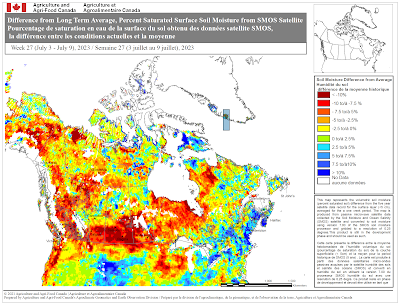
As of July 10, 2023 most Prairie regions have well below normal soil moisture with <=40 of normal (Figure 1).  However, some areas including the Edmonton region have somewhat higher amounts (Figure 1).  Based on satellite data from July 3-9, 2023, large areas of the Prairies are still dealing with dry conditions and would only have <5 to 15% of surface soil moisture (VMC) (Figure 2). Corresponding, satellite images for July 3-9, 2023, 2023 show well below long term average soil moisture levels for large areas of the Prairies, including regions where sclerotinia stem rot can occur (Figure 3). However, some areas including the Edmonton region to eastern Alberta and a small area of northwestern Saskatchewan are seeing somewhat higher soil moisture levels in relation to long term averages (Figure 3).  Note regional weather systems may have resulted in small localized rainfall events that contribute to and maintain soil moisture.  

As of July 10, the need to scout fields for apothecia of the stem rot fungus and/or to assess in-field risk is low.  This is based primarily on soil moisture maps although most canola is now flowering, while early seeded and/or drought stressed fields are likely finishing flowering (Figures 1-3).  However, in some Prairie regions past and current rainfall will likely trigger the start and/or continuation of the sclerotial germination process, which can take up to three weeks (Figure 4).  Further rainfall and crop canopy closure may increase the risk of sclerotial germination and apothecia production.  Areas in the Edmonton region and northwestern Saskatchewan may currently have soil moisture conditions somewhat conducive for sclerotial germination, especially were localized rainfall has occurred.  In these areas, in-crop scouting for apothecia and the use of available stem rot risk assessment tools may be needed over the next 1-2 weeks as part of fungicide use decisions (https://www.canolacouncil.org/canola-encyclopedia/diseases/sclerotinia-stem-rot/#forecasting-and-risk-assessment, https://tinyurl.com/bp6dchvx).   

Previously, the PCDMN tweeted some tips for practical assessment of the risk of sclerotinia stem rot, including the wet pants test, and these will complement the other tools that are available.  See: https://twitter.com/pcdmn/status/1143578383537889281 and https://drive.google.com/file/d/1cC1gNcLq-L5Dk2tUXG-vmEmW_6oJ-kAd/view?usp=sharing.

Background information on the soil moisture maps can be found at the following link: New for 2023: Prairie Soil Moisture Maps.

Given dry conditions, especially prior to mid-June, sclerotial germination would be delayed, although recent rains in some regions have likely triggered the germination process. Normally it takes about 3 weeks of wet soil conditions and moderate temperatures for germination and production of apothecia.  This period may be as short as 2 weeks if some moisture was received earlier in June, which may pre-condition sclerotia.  Delayed germination and apothecia development may mean that sclerotinia spore loads in the air are limited as the crop or portions of the crop come into bloom in 2023.  This may mean that an early bloom fungicide application may not represent the best target.  However, in crops with reasonable yield potential and where risk tools indicate increasing risk as flowering continues, later fungicide application at full bloom may be considered.  Note in areas were rainfall occurred and soil moisture levels are conducive, later seeded canola may be at risk during the early bloom period.  Tools such as the Spornado spore trap (https://2020seedlabs.ca/services/spornado/) and petal testing services (https://www.seedtesting.com/disease-testing-sclerotinia/; https://quantumgenetix.com/product/sclerotinia-white-mold/) can provide guidance related to the level of sclerotinia inoculum and stem rot risk as the crop starts and continues to flower.  Note these need to be combined with other risk tools to provide a complete picture of stem rot risk in relation to host, pathogen and environment factors, i.e. the disease triangle.  If fungicides are being considered, accounting for the most common crop growth stage in a field should be considered to help guide the timing(s) used.  Fortunately, most fungicide products have a window from 20-50% bloom, which represents a range of growth stages.  Note available risk assessment tools will provide information related to stem rot risk and whether a fungicide is needed from 20-50% bloom.


Figure 1.  Percentage of normal soil moisture (drought model) as of July 10, 2023.  Courtesy of Agriculture and Agri-Food Canada's Science and Technology Branch, AAFC Geomatics.  


Figure 2.  Percent saturated surface soil moisture from SMOS satellite data, July 3-9, 2023.  Courtesy of Agriculture and Agri-Food Canada's Science and Technology Branch, AAFC Geomatics. 


Figure 3.  Difference from long term average, percent saturated surface soil moisture from the Soil Moisture and Ocean Salinity (SMOS) data, July 3-9, 2023.  Courtesy of Agriculture and Agri-Food Canada's Agroclimate Geomatics and Earth Observation Division.


Figure 4.  Seven day cumulative rainfall (mm) as of July 12, 2023 observed across the Canadian prairies. Prepared by Agriculture and Agri-Food Canada's Science and Technology Branch. Data provided through partnership with Environment Canada, Natural Resources Canada, Provincial and private agencies.  

Disclaimer

Information related to soil moisture is OFFERED TO THE PUBLIC FOR INFORMATIONAL PURPOSES ONLY. Agriculture and Agri-Food Canada, and their employees assume no liability from the use of this information.  Soil moisture conditions will vary depending on soil texture, and localized rainfall and temperature conditions.  Sclerotinia stem rot risk will vary depending on host, pathogen and weather factors, and farmers and consultants are encouraged to use currently available risk assessment tools (https://www.canolacouncil.org/canola-encyclopedia/diseases/sclerotinia-stem-rot/#forecasting-and-risk-assessment).  Mention of a particular product or service does not represent an endorsement by PCDMN or the organizations involved with the PCDMN.

Friday, July 7, 2023

Prairie soil moisture maps: July 3, 2023

Prairie soil moisture levels and need to scout for apothecia of the sclerotinia stem rot pathogen, July 3, 2023

 As of July 3, 2023 most Prairie regions have well below normal soil moisture with large areas with <40 to 60% of normal (Figures 1-3).  However, some areas including the Edmonton region and down towards Calgary have somewhat higher amounts at 60 to 85% of normal soil moisture levels (Figure 1).  Based on satellite data from June 26-July 2, 2023, large areas of the Prairies are still dealing with dry conditions and would only have <5 to 20% surface soil moisture (VMC) (Figure 2). Corresponding, satellite images for June 26-July 2, 2023 show well below long term average soil moisture levels for large areas of the Prairies, including regions where sclerotinia stem rot can occur (Figure 3). Previously, the Edmonton area was seeing soil moisture levels increasing, however for the period up to July 3 they are starting to decline in this region and down the Highway 2 corridor.  This may partly reflect a reduction in rainfall from June 26 to July 3, 2023 (Figures 1-4).  Some smaller regions in the northwestern cropping areas in Saskatchewan, northwest of Edmonton and in Manitoba have had some rainfall and soil moisture levels are 15-30%, although in Manitoba soil moisture levels in these areas still remain relatively low (Figures 1-4).  Note regional weather systems may have resulted in small localized rainfall events that maintain and contribute to soil moisture.  

As of July 3, the need to scout fields for apothecia of the stem rot fungus and/or to assess in-field risk is low.  This is based primarily on soil moisture maps as canola crops have or will shortly start flowering (Figures 1-4).  However, in some Prairie regions past and current rainfall will likely trigger the start and/or continuation of the sclerotial germination process, which can take up to three weeks.  Further rainfall and crop canopy closure may increase the risk of sclerotial germination and apothecia production.  Areas in the Edmonton region and south to the Olds regions, northwestern Saskatchewan still likely have soil moisture conditions conducive for sclerotial germination, especially were localized rainfall has occurred.  In these areas, in-crop scouting for apothecia and the use of available stem rot risk assessment tools may be needed over the next 1-3 weeks as part of fungicide use decisions (https://www.canolacouncil.org/canola-encyclopedia/diseases/sclerotinia-stem-rot/#forecasting-and-risk-assessment, https://tinyurl.com/bp6dchvx).   

Previously, the PCDMN tweeted some tips for practical assessment of the risk of sclerotinia stem rot, including the wet pants test, and these will complement the other tools that are available.  See: https://twitter.com/pcdmn/status/1143578383537889281 and https://drive.google.com/file/d/1cC1gNcLq-L5Dk2tUXG-vmEmW_6oJ-kAd/view?usp=sharing.

Background information on the soil moisture maps can be found at the following link: New for 2023: Prairie Soil Moisture Maps.

We continue to hear questions from growers and consultants regarding fungicide need and timing and challenges associated with variable crop development for summer 2023.  Given dry conditions, especially prior to mid-June, sclerotial germination would be delayed, although recent rains in some regions has likely triggered the germination process. Normally it takes about 3 weeks of wet soil conditions and moderate temperatures for germination and production of apothecia.  This period may be as short as 2 weeks if some moisture was received earlier in June, which may pre-condition sclerotia.  Delayed germination and apothecia development may mean that sclerotinia spore loads in the air are limited as the crop or portions of the crop come into bloom in 2023.  This may mean that an early bloom fungicide application may not represent the best target.  However, in crops with reasonable yield potential and where risk tools indicate increasing risk as flowering continues, later fungicide application at full bloom may be considered.  Note in areas were rainfall occurred and soil moisture levels are conducive, later seeded canola may be at risk during the early bloom period.  Tools such as the Spornado spore trap (https://2020seedlabs.ca/services/spornado/) and petal testing services (https://www.seedtesting.com/disease-testing-sclerotinia/; https://quantumgenetix.com/product/sclerotinia-white-mold/) can provide guidance related to the level of sclerotinia inoculum and stem rot risk as the crop starts flowering.  Note these need to be combined with other risk tools to provide a complete picture of stem rot risk in relation to host, pathogen and environment factors, i.e. the disease triangle.  If fungicides are being considered, accounting for the most common crop growth stage in a field should be considered to help guide the timing(s) used.  Fortunately, most fungicide products have a window from 20-50% bloom, which represents a range of growth stages.  Note available risk assessment tools will provide information related to stem rot risk and whether a fungicide is needed from 20-50% bloom.


Figure 1.  Percentage of normal soil moisture (drought model) as of July 3, 2023.  Courtesy of Agriculture and Agri-Food Canada's Science and Technology Branch, AAFC Geomatics.  


Figure 2.  Percent saturated surface soil moisture from SMOS satellite data, June 26-July 2, 2023.  Courtesy of Agriculture and Agri-Food Canada's Science and Technology Branch, AAFC Geomatics. 


Figure 3.  Difference from long term average, percent saturated surface soil moisture from the Soil Moisture and Ocean Salinity (SMOS) data, June 26-July 2, 2023.  Courtesy of Agriculture and Agri-Food Canada's Agroclimate Geomatics and Earth Observation Division.


Figure 4.  Figure 1. Seven day cumulative rainfall (mm) observed across the Canadian prairies for the periods of June 12-18 (top) and 19-25 (middle), June 26 to July 2 (bottom), 2023.


Disclaimer

Information related to soil moisture is OFFERED TO THE PUBLIC FOR INFORMATIONAL PURPOSES ONLY. Agriculture and Agri-Food Canada, and their employees assume no liability from the use of this information.  Soil moisture conditions will vary depending on soil texture, and localized rainfall and temperature conditions.  Sclerotinia stem rot risk will vary depending on host, pathogen and weather factors, and farmers and consultants are encouraged to use currently available risk assessment tools (https://www.canolacouncil.org/canola-encyclopedia/diseases/sclerotinia-stem-rot/#forecasting-and-risk-assessment).  Mention of a particular product or service does not represent an endorsement by PCDMN or the organizations involved with the PCDMN.

Sunday, July 2, 2023

2023 Cereal Rust Risk Report (June 21-27, 2023)

The latest Prairie wind trajectory cereal rust risk report is available for download now at the following link: June 21-27, 2023 report.  

As of the period of June 21-27, 2023 the overall Prairie cereal rust risk assessment and need for in-crop scouting is as follows: 

Pacific Northwest – There was moderate number of reverse wind trajectories that passed over the PNW region and into the Prairies.  Rainfall has recently occurred especially in central Alberta to the south Peace River region, as well as some areas of southeastern Saskatchewan and Manitoba.  However, given limited stripe rust development in the PNW, as of June 27, 2023 the risk of stripe rust appearance from the PNW is low and scouting for this disease in the Prairie region is generally not urgent.


Kansas-Nebraska corridor – Given a very low number of wind trajectories from this region and generally low rust levels in commercial fields in this corridor, as of June 27, 2023 the risk of stem, leaf, stripe, and crown rust appearance from the Kansas-Nebraska corridor is generally low and scouting for these diseases in the Prairies is not urgent.  Recent reports in mid-late June of stripe, leaf and stem rust in Kansas and Nebraska, and a recent report of stem rust in South Dakota may represent somewhat of a concern. However, the number of trajectories was reduced for June 21-27, although rainfall did occur in southeastern Saskatchewan and Manitoba.   Farmers and consultants in the central-eastern Prairies should consider keeping an eye out for stripe and stem rust development, especially in fields planted to susceptible varieties.


Thursday, June 29, 2023

Prairie soil moisture maps: June 26, 2023

Prairie soil moisture levels and need to scout for apothecia of the sclerotinia stem rot pathogen, June 26, 2023

 As June 26, 2023 most Prairie regions have well below normal soil moisture with large areas with <40 to 60% of normal levels (Figures 1-3).  However, some areas including the Edmonton region have 85-115% of normal soil moisture levels (Figure 1).  Based on satellite data from June 19-25, 2023, large areas of the Prairies are still dealing with dry conditions and would only have <5 to 20% surface soil moisture (VMC) (Figure 2).  However, some regions are seeing soil moisture levels increasing due to recent rains including the Edmonton region, and some smaller regions in the northern cropping areas in Saskatchewan and Manitoba (Figure 2).  Corresponding, satellite images for June 19-25 show well below long term average soil moisture levels for large areas of the Prairies including regions where sclerotinia stem rot can occur (Figure 3). However, as a result of rainfall over the last few weeks, areas including the Edmonton region and south towards Red Deer are closer to normal or above normal.   

As of June 26, the need to scout fields for apothecia of the stem rot fungus and/or to assess in-field risk is low.  This is based primarily on soil moisture maps as canola crops have or will shortly start flowering (Figures 1-3).  However, recent rainfall over some Prairie regions will likely trigger the start and continuation of the sclerotial germination process, which can take up to three weeks.  Further rainfall and crop canopy closure may increase the risk of sclerotial germination and apothecia production.  Areas in the Edmonton region and south to Red Deer likely have soil moisture conditions conducive for sclerotial germination.  In these areas in-crop scouting for apothecia and the use of available stem rot risk assessment tools may be needed over the next 1-3 weeks as part of fungicide use decisions (https://www.canolacouncil.org/canola-encyclopedia/diseases/sclerotinia-stem-rot/#forecasting-and-risk-assessment). 

Background information on the soil moisture maps can be found at the following link: New for 2023: Prairie Soil Moisture Maps.

Recent questions from growers and consultants have focused on fungicide need and timing and challenges associated with variable crop development for summer 2023.  Given dry conditions, especially prior to mid-June, we may have delayed sclerotial germination that has been triggered by recent rains in some regions. Normally it takes about 3 weeks of wet soil conditions and moderate temperatures for germination and production of apothecia.  This period may be as short as 2 weeks if some moisture was received earlier in June, which may pre-condition sclerotia.  Delayed germination and apothecia development may mean that sclerotinia spore loads in the air are limited as the crop or portions of the crop come into bloom.  This may mean that an early bloom fungicide application may not represent the best target.  However, in crops with reasonable yield potential and where risk tools indicate increasing risk as flowering continues, later fungicide application at full bloom may be considered.  Tools such as the Spornado spore trap (https://2020seedlabs.ca/services/spornado/) and petal testing services (https://www.seedtesting.com/disease-testing-sclerotinia/; https://quantumgenetix.com/product/sclerotinia-white-mold/) can provide guidance related to the level of sclerotinia inoculum and stem rot risk as the crop starts flowering.  Note these need to be combined with other risk tools to provide a complete picture of stem rot risk in relation to host, pathogen and environment factors, i.e. the disease triangle.  If fungicides are being considered, accounting for the most common crop growth stage in a field should be considered to help guide the timing(s) used.  Fortunately, most fungicide products have a window from 20-50% bloom, which represents a range of growth stages.  Note available risk assessment tools will provide information related to stem rot risk and whether a fungicide is needed from 20-50% bloom.


Figure 1.  Percentage of normal soil moisture (drought model) as of June 26, 2023.  Courtesy of Agriculture and Agri-Food Canada's Science and Technology Branch, AAFC Geomatics.  


Figure 2.  Percent saturated surface soil moisture from SMOS satellite data, June 19-25, 2023.  Courtesy of Agriculture and Agri-Food Canada's Science and Technology Branch, AAFC Geomatics. 


Figure 3.  Difference from long term average, percent saturated surface soil moisture from the Soil Moisture and Ocean Salinity (SMOS) data, June 19-25, 2023.  Courtesy of Agriculture and Agri-Food Canada's Agroclimate Geomatics and Earth Observation Division.


Disclaimer

Information related to soil moisture is OFFERED TO THE PUBLIC FOR INFORMATIONAL PURPOSES ONLY. Agriculture and Agri-Food Canada, and their employees assume no liability from the use of this information.  Soil moisture conditions will vary depending on soil texture, and localized rainfall and temperature conditions.  Sclerotinia stem rot risk will vary depending on host, pathogen and weather factors, and farmers and consultants are encouraged to use currently available risk assessment tools (https://www.canolacouncil.org/canola-encyclopedia/diseases/sclerotinia-stem-rot/#forecasting-and-risk-assessment).  Mention of a particular product or service does not represent an endorsement by PCDMN or the organizations involved with the PCDMN.